When people talk about the toughest creatures on Earth, they usually think of sharks, lions, or maybe cockroaches. But the real champion of survival is something you’ve probably never seen without a microscope: tardigrade or “water bear.”
And trust me, this tiny creature makes everything else look fragile.
What Exactly Is a Tardigrade?
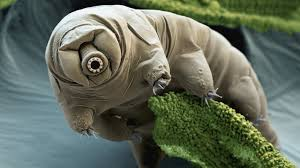
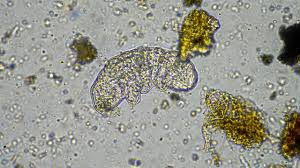
Tardigrades are microscopic animals, usually measuring between 0.1 and 1 millimeter. That means you could fit dozens on the tip of a needle.
They have:
- 8 stubby legs
- Tiny claws
- A plump, segmented body
Under a microscope, they look like a mix between a bear, a vacuum cleaner, and something from outer space.
They live pretty much everywhere:
- Moss and lichens
- Soil
- Freshwater
- Deep ocean environments
Basically, if there’s a bit of moisture, there’s a good chance tardigrades are hanging out there.
The Secret Weapon: Cryptobiosis
The reason tardigrades are so famous comes down to one incredible ability: cryptobiosis.
In simple terms, it’s like hitting a biological pause button.
When conditions get bad (no water, extreme temperatures, radiation), the tardigrade:
- Dries out almost completely
- Shrinks into a curled-up state called a “tun”
- Slows its metabolism to nearly zero
At this point, it’s not really “alive” in the normal sense — but not dead either.
Then, when water comes back?
It just rehydrates and goes back to normal life like nothing happened.
No drama. No recovery period. Just… back to business.
Extreme Survival: Breaking All the Rules
Let’s talk about what tardigrades can actually survive — because this is where things get wild.
❄️ Extreme Cold
Tardigrades can endure temperatures close to −270°C, which is just a few degrees above absolute zero.
That’s colder than anything naturally found on Earth.
🔥 Extreme Heat
They can also handle temperatures above 150°C for short periods.
That’s hotter than boiling water — hot enough to destroy most forms of life instantly.
☢️ Radiation Resistance
Tardigrades can survive radiation levels thousands of times higher than what would kill a human.
Their secret?
They have special proteins that protect and repair their DNA, preventing long-term damage.
🌊 Pressure Extremes
Whether it’s:
- The crushing pressure of the deep ocean
- Or the complete lack of pressure in space
Tardigrades don’t care. They adapt to both.
🚀 Survival in Space
Yes, this actually happened.
Scientists sent tardigrades into space, exposing them to:
- Vacuum conditions
- Intense solar radiation
When they returned to Earth, many of them survived and continued living normally.
Let that sink in — an animal that can survive outer space.
How Do They Pull This Off?
Tardigrades aren’t just lucky — they’re biologically engineered for survival.
Here’s how they do it:
🧬 DNA Protection
They produce unique proteins that shield their genetic material, reducing damage from radiation and stress.
💧 Water Replacement Trick
When they dry out, they replace water in their cells with special molecules that keep everything stable, almost like biological antifreeze.
🧊 Glass-Like State
Their bodies enter a state similar to glass, preventing structures from collapsing or breaking.
It’s like freezing time — but without ice crystals destroying cells.
Why Scientists Are Obsessed With Tardigrades
Tardigrades aren’t just cool — they’re incredibly useful for research.
Scientists are studying them to:
- Improve vaccine storage without refrigeration
- Develop better radiation protection
- Learn how to preserve human cells and organs
- Explore the possibility of life on other planets
If something can survive space, it changes how we think about life in the universe.
What Do Tardigrades Eat?
Despite all their superpowers, tardigrades are pretty chill creatures.
They feed on:
- Algae
- Bacteria
- Plant cells
Some species are even predators, feeding on smaller microorganisms.
No hunting humans. No sci-fi horror scenarios.
Just microscopic grazing.
Final Thought: Small but Unstoppable
The tardigrade proves something fascinating:
You don’t have to be big, fast, or dangerous to be powerful.
This tiny creature can:
- Survive boiling heat
- Freeze solid
- Handle extreme radiation
- And even endure outer space
All while living quietly in a patch of moss.
Not bad for something smaller than a grain of sand.